Umbra
also known as: umbras
Also available in: Polski · Čeština · Deutsch
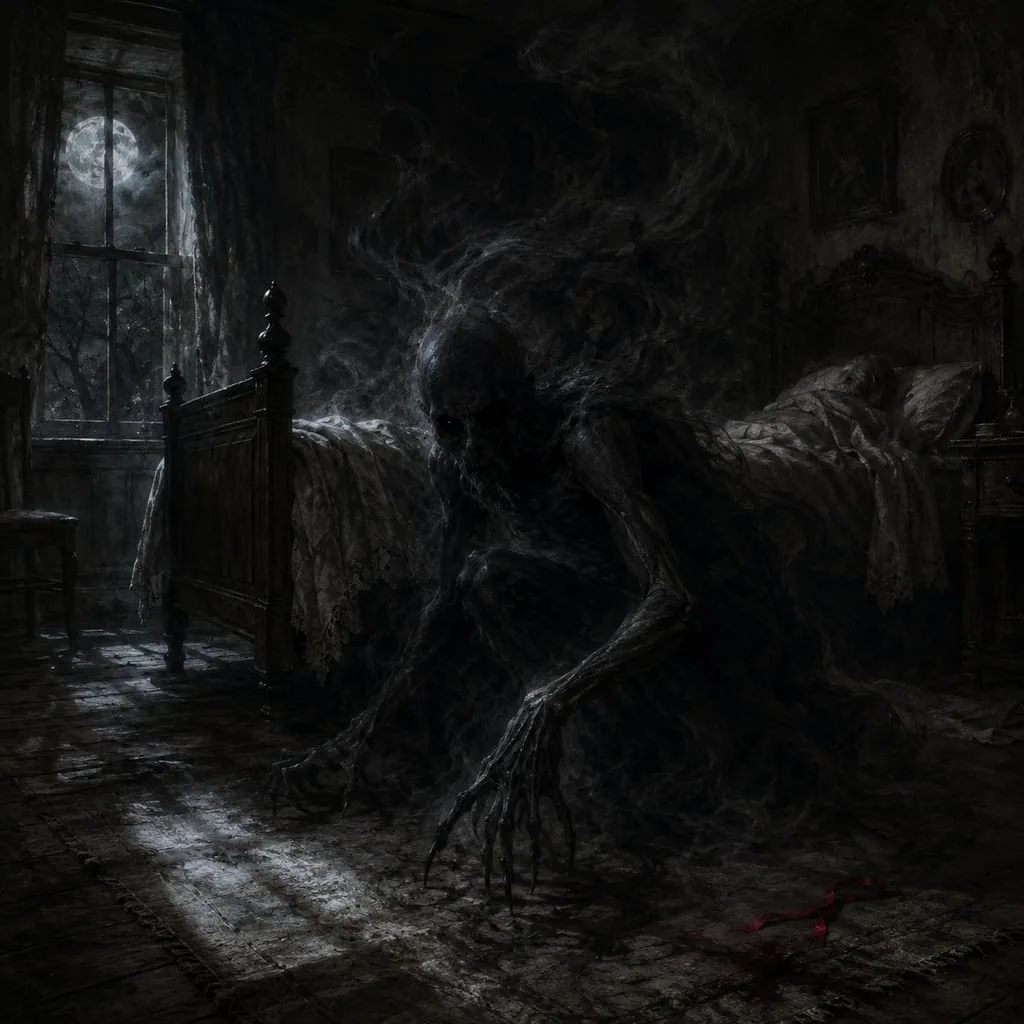
What is an umbra
The umbra is a specter from the expansion “The Witcher 3: Blood and Wine” (2016) - an apparition invisible even to a witcher’s eyes, believed to be the ghost of a dead person who did evil in life and cannot find peace after death without forgiveness. As a monster it does not appear in Andrzej Sapkowski’s books - the Polish word for it, zmora, turns up there only in the folk superstitions of the characters. It is a creature of the game, built on the Slavic idea of a night demon that torments sleepers.
In the Polish version of the game it is simply called zmora, in the English version - umbra.
The umbra in the game
The “Blood and Wine” bestiary opens with the mocking opinion of Sabine of Dal, mystic and priestess of the Prophet Lebioda: an umbra is merely an unclean conscience, and the stories about it are made up by those who have sinned and cannot sleep. It goes on, however, to give the philosophers’ explanation: an evil deed, especially harm done to an innocent creature, leaves a lasting trace in the soul and does not let it depart even after death.
In its ethereal form an umbra can take any shape. It cannot be seen with the naked eye - the only known way to perceive it is to enter an altered state of consciousness with a strong hallucinogen, for example a brew of graytop. Some animals, however, can see it, especially horses. The signs of its presence are indirect: dead moths, blood on the victim’s bedding, the victim’s growing weakness. The umbra visits the living at night, drinks their blood and gradually drains their strength.
“Equine Phantoms”
The only umbra Geralt meets in the game is the ghost from the side quest “Equine Phantoms” in Toussaint. The hermit Pinastri, associated with the Flagellants, greets Geralt by asking whether he is really human, and then complains that every night she is tormented by an invisible apparition in the shape of a horse. She can pay for help only in potatoes. In the hut the witcher finds dead moths, dried mushrooms and bloody traces on the bed which lead out of the hermitage and then break off. To track the apparition he drinks the hallucinogenic graytop brew - he passes out, and when he wakes up he begins to understand the speech of animals. Roach speaks to him in a male voice and investigates the case together with him.
The horse-umbra appears in front of the hermitage and flees. The chase leads to the Mont Crane Cemetery, where spectral panthers bar the way, and further on to the grave of the knight Marcello Clerici, Pinastri’s former lover. Marcello, once poor, became a squire and then a knight in order to rescue her from poverty. At a tournament, thrown from the saddle, he beat his horse Blaze to death before her eyes, and she never forgave him. After his death he returns to her as a horse-umbra - unaware that he has become a demon to her - because he seeks forgiveness. The quest can end in two ways: Roach can forgive the ghost in the name of the slain horse, and then the umbra departs for good, or Geralt fights it with a silver sword coated in Specter oil. Victory in battle, however, brings only a moment of peace - the ghost will eventually return. The reward is a knight’s steel sword from the tombstone, and after the fight a trophy from the umbra: as invisible as the umbra itself (only the rope with the hook can be seen) and impossible to sell or throw away.
Zmory in the books
In the saga the word zmora (plural zmory) does not denote a specific monster, only a folk notion. In “The Tower of the Swallow” there is a long speech about the superstitions connected with Saovine Eve: on that night the spirits of the dead, chilled in the bare fields, are drawn to human homes in search of warmth and food, so a bowl of food should be set out for them on the threshold or in the barn. If the zmory find nothing there, after midnight they will come into the cottage themselves. Zmory are also invoked in Sapkowski’s prose by a frightened child who asks its mother whether demons, the Wild Hunt or zmory from hell are coming - and the mother answers that it is something worse: people.
The zmora in folk beliefs
Outside the world of The Witcher the zmora (also mora, mara) is a demon of Slavic and Polish folk belief. The name is linked to an old root meaning death, hence its kinship with Marzanna, the Slavic goddess of winter and death, and with the Polish saying “sen mara, Bóg wiara” (dreams are illusions, faith is in God). The soul of a sinner, of someone who had been wronged, or of someone who died without confession was believed to become a zmora. At night it sits on the chest of sleepers, smothers them, drinks their blood and sends nightmares - today these tales are explained by sleep paralysis. That is why in Polish “zmora” still means a bad dream or something that gives no peace. It was also believed that a zmora that had fed would ride the horses in the stable, driving them to exhaustion, and then leave them with tangled manes. The sinful soul, the nightly drinking of blood and the horse motif in the “Blood and Wine” quest clearly draw on these legends.
The umbra should not be confused with the nocnica, which is a separate being in the world of The Witcher.
Frequently asked questions
Does the umbra appear in the Witcher books? Not as a monster - it appears only in the expansion “The Witcher 3: Blood and Wine”. In “The Tower of the Swallow” zmory are mentioned only in folk superstitions about Saovine.
How to see an umbra in The Witcher 3? Only after drinking the hallucinogenic graytop brew, which the hermit Pinastri gives Geralt in the quest “Equine Phantoms”. Horses can also see the umbra.
Forgive the umbra or fight it? Forgiveness in the name of the slain horse settles the matter for good. Fighting gives a trophy, but the knight’s ghost will eventually return to the hermit.
How to defeat an umbra? With a silver sword coated in Specter oil - although in the quest “Equine Phantoms” this is a worse solution than forgiveness.
