Kikimore
also known as: kikimores, kikimora
Also available in: Polski · Čeština · Deutsch
What is a kikimore
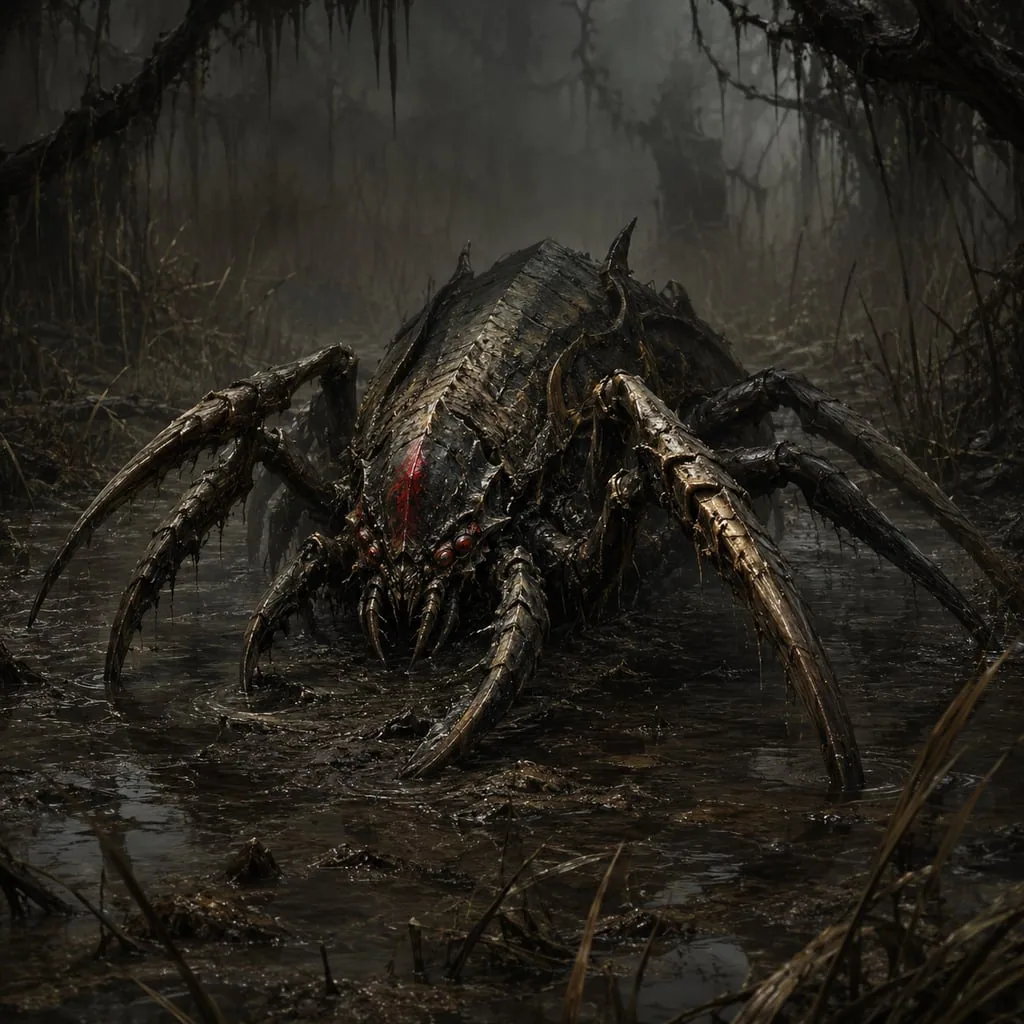
The kikimore (in the Polish original kikimora) is a swamp monster from Andrzej Sapkowski’s saga - a spider-like predator with many legs, classed as an insectoid in the games. The best-known kikimore in the books is a dead one: Geralt brings its carcass to the seaside town of Blaviken at the beginning of the short story “The Lesser Evil” from the collection “The Last Wish”. Sapkowski took the name from Slavic demonology, but created a completely different creature under it than the folk kikimora.
Appearance and habits
The people of Blaviken who look at the carcass see a spider-like shape covered in dried black skin, with several pairs of legs ending in hooked talons, a glassy eye with a vertical pupil and a maw full of needle-like fangs. It is most often compared to a cross between a spider and a crocodile, and the locals, without thinking much, call it a “reptile”.
The kikimore makes its nest in a swamp and hunts both by day and by night. Mainly animals, but when hunger presses it, it also attacks people. It lies in wait under the water, leaps out unexpectedly and pulls its victim to its maw with its legs, and the hooked talons make it impossible to break free. In “A Grain of Truth” Geralt, examining the bodies of travellers, considers a kikimore or a vypper, another swamp predator - but immediately rejects both, because there are no swamps nearby.
“The Lesser Evil”: the kikimore of Blaviken
The story opens with a sight that draws onlookers at the market: a witcher leading a horse on whose back lies something covered with a horse-blanket, and from under the blanket sticks out a bony, taloned paw. Geralt has killed the kikimore in the nearby swamps and hopes for payment. The alderman Caldemeyn has to disappoint him: nobody in Blaviken has put a bounty on it, so the witcher has done the job for nothing.
Caldemeyn advises him to try selling the carcass to the local wizard, who resides in a tower outside the town. This advice sets the whole plot in motion: the wizard turns out to be Stregobor, hiding from Renfri, and the visit to him draws Geralt into a conflict that ends in a massacre in the marketplace and the nickname the Butcher of Blaviken. The kikimore is therefore only a pretext here, but one of the most important stories of the cycle begins with it.
The kikimore in other books
In the saga the kikimore appears mainly as a name everyone knows. In “The Last Wish” it is put on a list of creatures that live only to kill - alongside the manticore, the wyvern, the striga and the werewolf. In “Time of Contempt” there is an anecdote about a boy drowned in a pond: instead of thinking of an ordinary cramp, people immediately shout that it was a drowner or a kikimore and that a witcher must be called. The kikimore is also mentioned in “Crossroads of Ravens”.
The kikimora in folklore
In Slavic beliefs, especially Eastern Slavic ones, the kikimora is a malicious household spirit, sometimes regarded as the wife of the domovoi. It takes the form of a tiny woman or becomes invisible; at night it wakes babies, tangles yarn and harms poultry, while it likes to spin itself - and the whirr of its spindle foretold misfortune. It shares only its name with Sapkowski’s swamp insect. This is a typical move for the author: a Slavic word, a completely new beast.
In the games
- “The Witcher” (2007): the game developers built a whole social species out of the book’s kikimore, organized like a termite colony. Kikimore workers, resembling spiders, gather food and dig tunnels. Kikimore warriors, massive and armored like beetles, defend the colony and spit acid, blinding the opponent. At the top of the hierarchy stands a blind queen who lays eggs incessantly. Kikimores live in the swamps near Vizima. Silver and Insectoid oil help. The queen in the Salamandra hideout cannot be defeated in an ordinary fight - Geralt flees from her through the tunnels and brings the ceiling down on her with the Aard Sign.
- “The Witcher 3: Blood and Wine”: workers and warriors return in Toussaint. Their venom raises the witcher’s toxicity level, which quickly becomes dangerous after drinking potions; White Honey, which resets toxicity, comes in handy. Kikimores are immune to Axii and vulnerable to Insectoid oil, bombs that work on insectoids, the Igni Sign and silver. Warriors lead whole packs of workers into battle.
Apart from The Witcher 1 and the “Blood and Wine” expansion, kikimores are only mentioned in the games.
In the series
The Netflix series opens precisely with a kikimore: in the first scene of the first episode (2019) Geralt fights it in a swamp and then brings its carcass to Blaviken, as in the short story.
Frequently asked questions
What monster does Geralt fight at the beginning of the series? A kikimore. The scene expands on the opening of the short story “The Lesser Evil”, in which Geralt brings a dead kikimore to Blaviken.
Is the kikimore in the books? Yes. Its carcass opens “The Lesser Evil”, and the name also comes up in “A Grain of Truth” and “Time of Contempt”, among others.
What oil to use against kikimores? Insectoid oil. In “Blood and Wine” it is also worth having White Honey, because kikimore attacks raise toxicity.
What is a kikimora in Slavic mythology? A malicious household spirit in the form of a small woman, not a swamp insect - Sapkowski borrowed only the name.
