Ghoul
also known as: ghouls
Also available in: Polski · Čeština · Deutsch
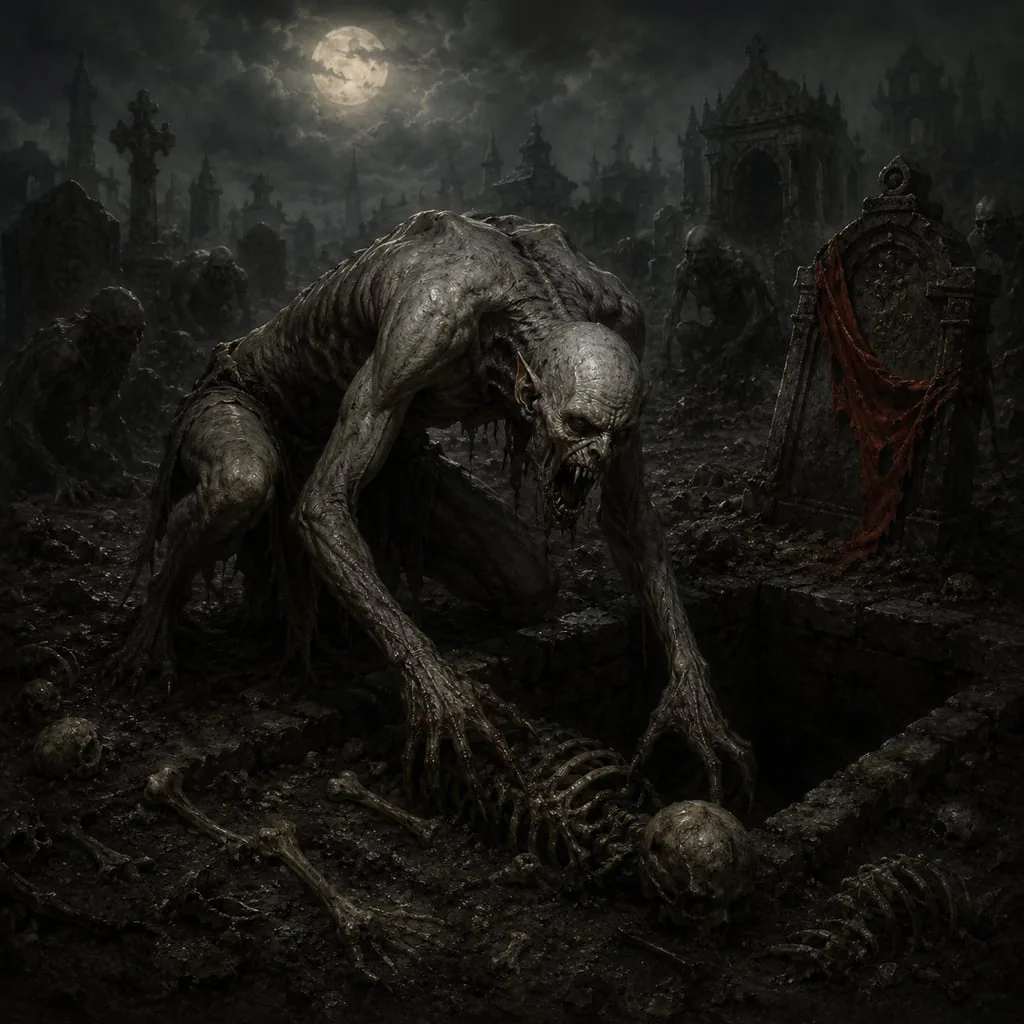
What is a ghoul
The ghoul is a monster that feeds on corpses, the best-known member of the necrophages in the world of The Witcher. It feeds in graveyards, by barrows, in crypts, necropolises and on battlefields - in other words, wherever the dead are buried or left behind. Carrion is not enough for it: when it is hungry or flies into a frenzy, it attacks the living too. In Andrzej Sapkowski’s books it appears in “The Last Wish”, “Blood of Elves”, “Baptism of Fire” and “The Tower of the Swallow”, and in CD Projekt RED’s games it is one of Geralt’s most frequent opponents.
According to the saga the ghoul, like its more dangerous relative the graveir, is a relic of the Conjunction of the Spheres. So it is neither a transformed human nor a ghost, but a creature that came to this world from another one and has no natural place in it.
The ghoul in the books
The scene that says the most about ghouls comes from “Blood of Elves”. In Kaer Morhen Vesemir quizzes Ciri on her knowledge of monsters, and the girl recites where the ghoul lives and what it eats. At the mention of battles she falls silent, because she remembers the fields after the battles at Sodden and in Transriver, strewn with corpses. Her teachers explain that this is exactly why she has to learn about ghouls: what you know and know how to fight stops being a nightmare. The most important canonical facts come from this lesson. The ghoul is vulnerable to silver, and also to bright light and fire. Even so, a witcher does not fight it by torchlight, because the light casts shadows that make it hard to keep one’s bearings. It is better to fight in the dark, by the light of the moon or the stars.
In “Baptism of Fire” ghouls frighten Geralt’s company. On the road the travellers find a hanged man on an oak whose legs have been gnawed to the bone, and the witcher recognises the work of necrophages. When they later have to spend the night in Fen Carn, an old elven cemetery, Zoltan Chivay is convinced that the barrows are swarming with ghouls and graveirs, and Milva readies a silver arrowhead she keeps especially for the purpose. Geralt reassures his companions that not every cemetery has its ghouls, but admits that in a fight they are incomparably more dangerous than marauders. That night, as it happens, the company meets someone else entirely: the vampire Regis.
In “The Last Wish” the ghoul comes up in Geralt’s reflections on creatures that live only to kill, alongside the manticore, the striga and the werewolf. In “The Tower of the Swallow” a folk tale about the night of Saovine mentions ghouls gnashing their teeth on that night.
Appearance and habits
Sapkowski does not describe the ghoul’s appearance in detail. The image was fixed by the games: a grey or deathly pale, thin creature with roughly human limbs, which moves on all fours like a dog or a badger. It has claws, powerful jaws that can crush bones and a face that resembles a human one but lacks any spark of reason. It is driven by a single urge: hunger for human flesh.
Ghouls feed in small groups, sometimes led by a stronger alghoul. They are most dangerous at dusk and at night. A single ghoul is no great threat to a witcher, but a pack can knock its victim down, surround it and begin devouring it alive.
In the games
- “The Witcher” (2007): ghouls roam the Outskirts of Vizima, the cemetery and the crypts, and Geralt takes contracts on them. The journal repeats a rumour that ghouls were once people forced into cannibalism who, after years in dark crypts, turned into monsters. This version exists only in the game and is not confirmed in the books. Silver and Necrophage oil work against them.
- “The Witcher 3: Wild Hunt”: ghouls are the first enemies in the game, in White Orchard during the quest “Lilac and Gooseberries”. Later they turn up wherever corpses lie, and the war in Velen provides more than enough of those. The bestiary warns that a wounded ghoul flies into a frenzy: it then attacks ferociously, paying no heed to its own wounds, and regenerates quickly. Such an individual has to be finished off first, and the Axii Sign stops the frenzy. Necrophage oil helps
- the same oil that works on the game’s other necrophages, including rotfiends and grave hags.
The most important advice is the same everywhere: do not let yourself be surrounded, separate ghouls from the pack and finish them off one by one.
Where the name comes from
The word comes from the Arabic “ghul”. In pre-Islamic and Arab beliefs this was the name of a desert demon that leads travellers astray and devours people. It reached Europe with translations of “One Thousand and One Nights”, and Western horror literature turned it into a corpse-eater haunting graveyards. That is the ghoul that found its way into the world of The Witcher.
Frequently asked questions
What is a ghoul vulnerable to? In the books, silver, bright light and fire. In the games, Necrophage oil as well.
Is a ghoul an undead human? Not in the saga. It is a relic of the Conjunction of the Spheres. The story of people turned into ghouls comes from the journal of the first “Witcher” game.
How does a ghoul differ from an alghoul and a graveir? The alghoul is a stronger variety that sometimes leads the pack. The graveir is bigger and more dangerous than a ghoul.
What oil to use against ghouls in The Witcher 3? Necrophage oil. An enraged ghoul is best stopped with the Axii Sign before it regenerates.
