Forktail
also known as: forktails
Also available in: Polski · Čeština · Deutsch
What is a forktail
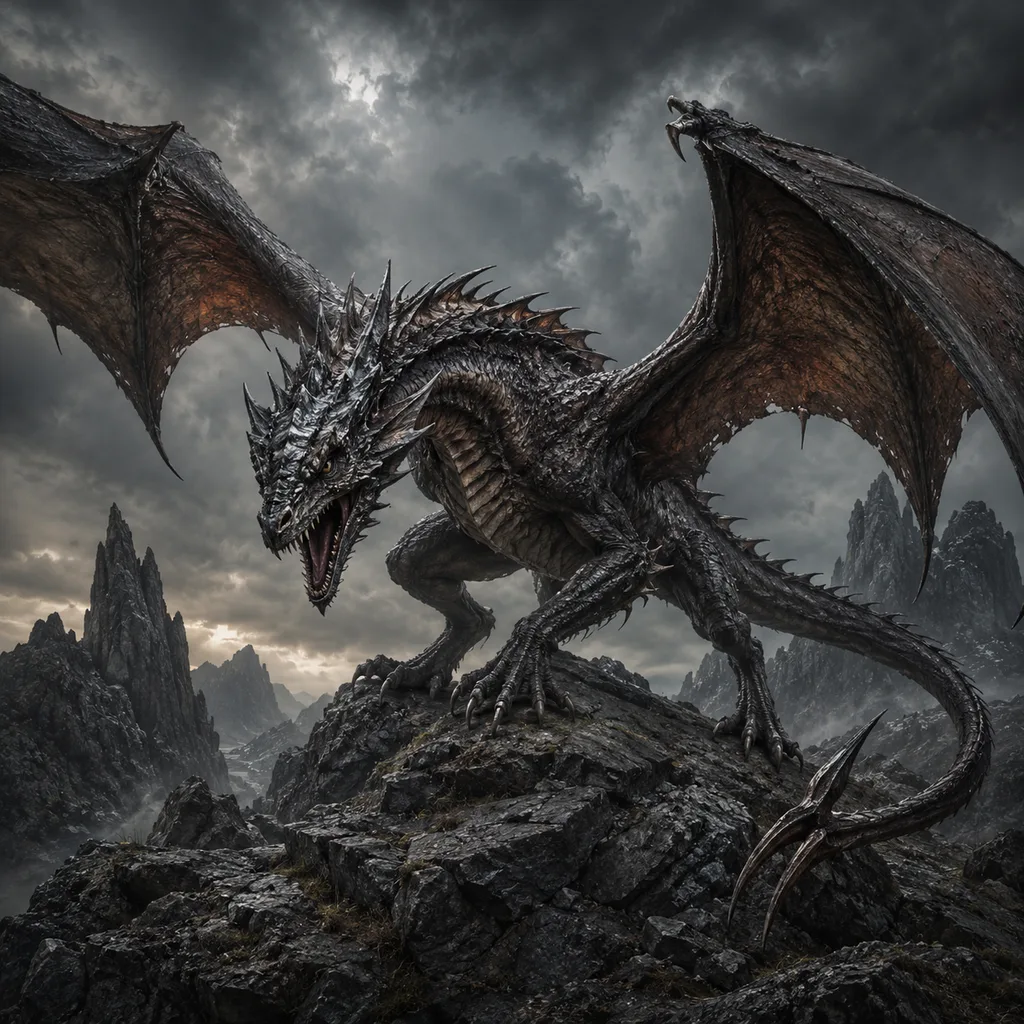
The forktail is a flying reptile from the draconid family, a relative of the wyvern, recognizable by its long tail ending in sharp, forked spikes. It is big, strong and non-sentient, and it hunts by day for cattle, pigs and sometimes people. People often take it for a dragon, but it is not one: dragons are sentient and rare, while the forktail is simply a dangerous animal. That is why witchers, who do not kill dragons, take contracts on forktails without hesitation.
In Andrzej Sapkowski’s short stories the forktail appears only in mentions, in “The Voice of Reason” and “The Bounds of Reason”. It became a full-fledged monster in CD Projekt RED’s games, especially in “The Witcher 3: Wild Hunt”.
In the short stories
In “The Voice of Reason” (“The Last Wish”) Geralt describes how short of work he is, and gives as an example a forktail he came across. Not a big one, some five arshins from snout to the tip of its tail, and it was flying with a sheep in its talons. When the witcher asked in the village about payment, the peasants fell to their knees and begged him not to touch the reptile: it was the favourite of the baron’s youngest daughter, and for every scale that fell off its back the baron would burn the village down. There is also the thought that it is probably the last draconid within a thousand miles and that instead of terror it now inspires only sentiment. The scene captures the main theme of the collection well: monsters are dwindling, and witchers are becoming unnecessary.
In “The Bounds of Reason” (“Sword of Destiny”) Geralt cuts short a conversation about hunting a dragon: he hunts forktails, just as he hunts dracolizards and flying drakes, but not true dragons.
Appearance
The forktail has a slender, scaly body, a long neck, a horned head with a snout full of teeth and powerful membranous wings, on which it can also prop itself up on the ground like a bat. The most dangerous part is the tail. The spikes at its end are as sharp as blades, and a blow can pierce an oak shield together with the arm holding it. Hence the veterans’ joke that instead of “forktail” it should be called “swordtail”.
Habits
Forktails nest on rocky hills, in mountains and in wild places far from human settlements, although they sometimes venture into swamps. They usually hunt alone, more rarely in pairs, and are active by day. They attack from the air: they swoop down on their prey, knock it over with a blow of their wings and pin it down with their claws. On the ground they are less agile, but then they fight with their tail.
For a village a forktail is a disaster: within a few weeks it can wipe out a herd. The way to lure it is simple and has been known for generations: you tie a goat to a stake and wait in the bushes. Even witchers use it.
Forktail, dragon and wyvern
The forktail, the wyvern, the cockatrice and the basilisk belong to the draconids, that is the smaller, non-sentient flying reptiles. What sets the forktail apart from the wyvern is above all its forked tail instead of a venomous stinger. From the dragon it differs in everything except general shape: it is not sentient, does not speak and does not live for millennia. It is precisely this confusion of draconids with dragons that makes people persecute dragons for damage done by entirely different creatures.
In “The Witcher 3”
In “Wild Hunt” forktails live in Velen, on Skellige, in White Orchard, in the valley of Kaer Morhen, and in the “Blood and Wine” expansion also in Toussaint. Several quests revolve around them:
- The Dragon of Fyresdal: a contract on Skellige in which the locals take a forktail for a dragon.
- Hunting with Eskel: near Kaer Morhen, Geralt and Eskel set a trap for a forktail with a goat as bait. Fluid from its spinal cord then goes to Yennefer, who uses it to lift the curse from Uma.
How to fight a forktail
In “The Witcher 3” the forktail is vulnerable to Draconid oil. The Aard Sign and the Grapeshot bomb can knock it out of the air, and a crossbow comes in handy when it circles overhead. The tail spikes are venomous, so it is worth having the Golden Oriole potion. The most important thing is to watch out for the tail, but not only that: the forktail bites very quickly, so a witcher focused solely on the tail can easily end up feeling its teeth.
From a slain forktail you can harvest a mutagen for a decoction, which in the game strengthens the witcher, as well as other alchemical ingredients.
Frequently asked questions
Is a forktail a dragon? No. It is a draconid, a non-sentient relative of the wyvern, often mistaken for a dragon.
What oil to use against a forktail? In “The Witcher 3”, Draconid oil. The Aard Sign, the Grapeshot bomb and the Golden Oriole potion also come in handy.
Where to find a forktail in The Witcher 3? In Velen, on Skellige, in White Orchard, in the valley of Kaer Morhen and in Toussaint.
How does a forktail differ from a wyvern? The forktail has a forked tail with sharp spikes, the wyvern a tail ending in a venomous stinger.
